Air Movers
Low-profile, high-velocity fans placed along walls and across floors to push air over wet surfaces. Number and position follow the size and class of the loss.
High-Velocity Vapor Pressure Manipulation, Non-Invasive Cavity Drying, and Precision Moisture Metering.
Once the standing water is gone, the water that matters most is the water you cannot see: moisture inside drywall, framing, subfloor and concrete. Water mitigation is the process of finding that moisture, drying it with controlled airflow and dehumidification, and proving it is dry before mold, rot or odor can start. Our Tulsa crews set up, monitor and document structural drying across Tulsa County, 24 hours a day. We aim to arrive within 60 minutes.
The Critical Middle Stage
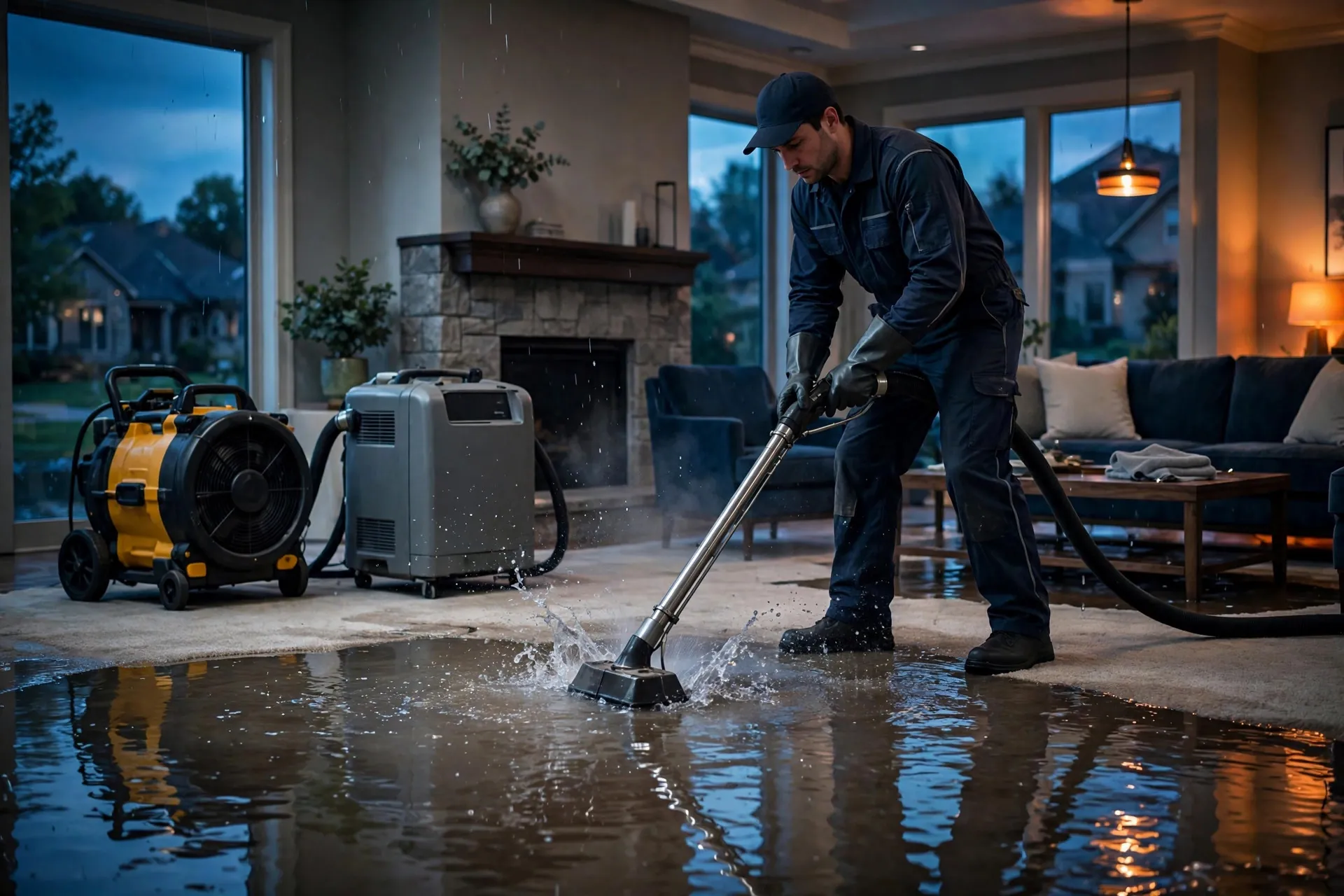
Water mitigation is the set of emergency steps that stop water damage from spreading and get a building dry: finding hidden moisture, setting up drying equipment, monitoring daily and confirming dry standards. The goal is to limit damage and prevent mold, not to rebuild.
Mitigation works against a clock. Materials that stay wet can begin to grow mold in about 24 to 48 hours, and prolonged wetness warps framing and floors. The earlier drying starts, the more material can be dried in place instead of replaced.
Know the Stages
People mix these up, and it affects who you hire and what your insurer pays for.
| Stage | What happens | Typical timing |
|---|---|---|
| 1. Extraction | Pumps and vacuums remove standing and absorbed liquid. See Emergency Water Extraction | First hours |
| 2. Mitigation (this page) | Moisture mapping, drying equipment, daily monitoring, controlled removal of unsalvageable materials | Usually 3 to 5 days, sometimes longer |
| 3. Repairs / rebuild | New drywall, flooring, paint, trim | After materials test dry |
Mitigation is the bridge. Skipping it and going straight to repairs is how hidden moisture ends up sealed behind fresh paint.
The Science
Professional drying follows four principles from the ANSI/IICRC S500 standard:
Bulk water out, so equipment dries moisture instead of puddles.
Air movers sweep the thin layer of saturated air off the surface so more moisture can evaporate.
Dehumidifiers pull the evaporated water out of the room. Without them, moisture just redistributes.
Warmer air holds more moisture and speeds evaporation, and closing off the wet area (a "drying chamber") keeps the equipment working on one space instead of the whole house.
Open windows and box fans fail because they only do the second step. In a Tulsa summer, the outside air is often as wet as the air inside, so opening windows can slow drying.
In Plain English
Psychrometrics is the science of air and moisture. Three readings guide every drying job:
The aim is to keep the indoor air much drier than the wet materials, so moisture always moves out of the structure and into the dehumidifier. Technicians take these readings at the start and then daily, and compare them to unaffected areas and outdoor air.
Pro-Grade Gear
Equipment is chosen by square footage, cubic footage, materials and water class, not by guesswork.
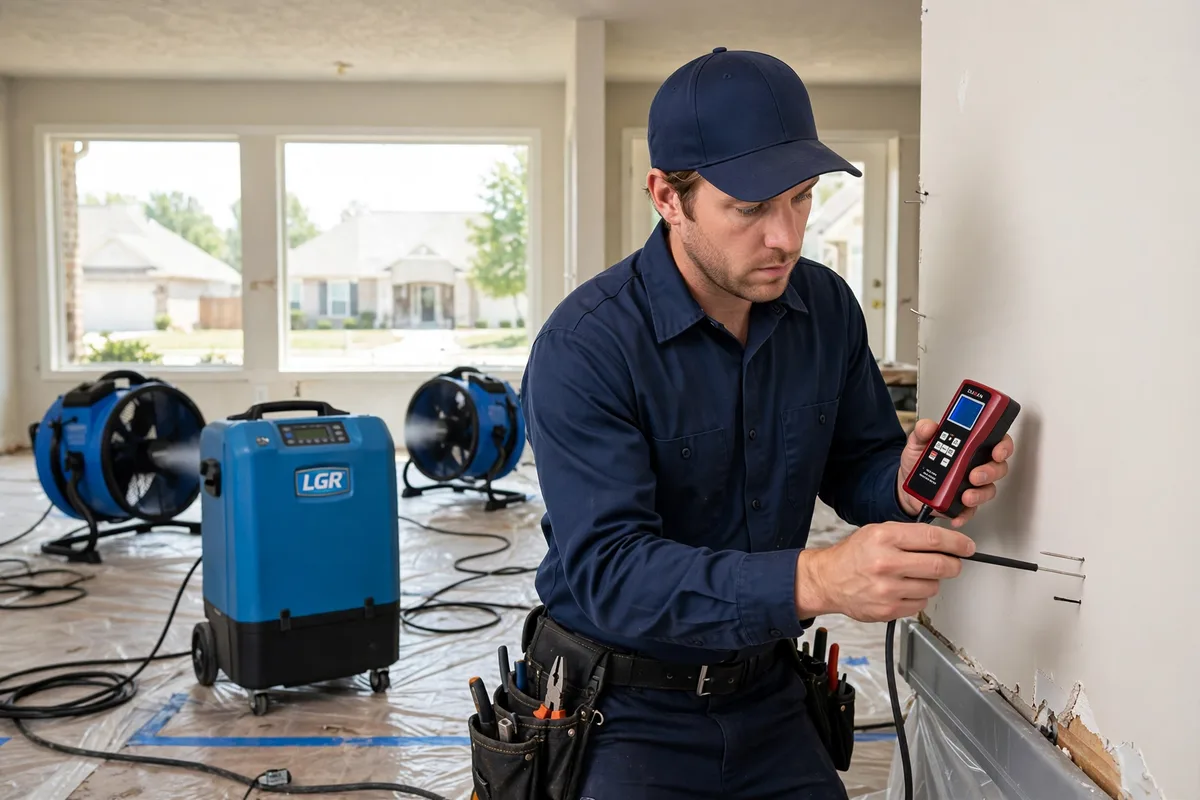
Low-profile, high-velocity fans placed along walls and across floors to push air over wet surfaces. Number and position follow the size and class of the loss.
Low-grain refrigerant dehumidifiers are built to keep pulling moisture from air that is already fairly dry, which standard dehumidifiers cannot do. They are the main workhorse of structural drying.
Used in cooler spaces or for very dry targets, such as basements, crawl spaces and some hardwood jobs.
Controlled airflow through small openings at baseboards or through drilled holes dries the space behind walls and under floors without removing every panel.
Pin and pinless meters read moisture in drywall, wood and concrete. Thermo-hygrometers read temperature, RH and GPP. Thermal cameras show cooler, wetter areas to guide where to check.
How We Work
We ask about the water source, how long it has been wet and what materials are affected, and give you safety steps while we travel.
Water source stopped, electrical hazards and ceiling risks checked.
We read moisture across floors, walls, ceilings and slab and mark the wet boundary. This is what the drying plan is based on.
We identify the contamination category and the class of loss, which decide equipment, scope and what must be removed.
Only materials that cannot be dried or are contaminated are removed, such as soaked pad or ceiling drywall.
Air movers, dehumidifiers and any cavity drying equipment placed, with the wet area contained.
Moisture content and atmospheric readings are logged every day and equipment is adjusted.
Equipment stays until materials read dry compared with unaffected reference readings. You receive the drying log.
Standing water still on the floor? See Emergency Water Extraction.
Know the Scale
The class of loss shows how deep water has soaked and how hard the job is to dry.
| Class | What it means | Typical drying |
|---|---|---|
| Class 1 | Small area, little absorption | Often 1 to 3 days |
| Class 2 | Whole room, carpet and pad, water wicked up walls | Often 3 to 5 days |
| Class 3 | Water from above, ceilings, walls and insulation soaked | Often 4 to 7 days |
| Class 4 | Deep moisture in dense materials like hardwood, plaster, concrete | Often 7 days or more, sometimes with specialty drying |
These are typical ranges. Humidity, material density, how long it sat wet and the size of the area move them up or down.
Material by Material
| Material | Approach | Common outcome |
|---|---|---|
| Drywall | Dry in place if it is clean-water, intact and recent. Cut and remove if swollen, crumbling or contaminated | Often dried if caught early |
| Plaster and lath | Slower, denser and can crack. Dried in place when possible, with careful monitoring | Common in older Tulsa homes |
| Insulation | Wet fiberglass and cellulose hold water and are usually removed | Replaced |
| Hardwood floors | Specialty drying, controlled and slow to avoid cracking. See Hardwood Floor Drying | Salvageable when early |
| Subfloor and framing | Dried with airflow, cavity access and dehumidification | Usually dried in place |
| Concrete slab | Slow to release moisture, dried with dehumidification and verified by readings | Dried, then checked before flooring goes back |
| Cabinets and baseboards | Toe-kicks and baseboards removed to dry behind them | Often saved |
| Carpet and pad | Pad is often replaced. Carpet can sometimes be dried and saved if clean-water | Case by case |
Save or Replace
We remove material when:
We dry in place when the water was clean, caught early and the material is still sound. This saves you demolition and repair costs. See also Mold Remediation if the loss is older than 48 hours.
Older home warning: homes built before about 1980 may contain asbestos in plaster, flooring, ceiling texture or pipe wrap, and homes before 1978 may have lead paint. Before demolition we recommend testing suspect materials. Do not scrape, sand or tear out material yourself.
While We Dry
Proof It Is Dry
This is a made-up example to show what daily monitoring looks like, not a real job.
| Day | Indoor air | Indoor RH | Indoor GPP | Drywall reading (wet area) | Action |
|---|---|---|---|---|---|
| 1 | 80 F | 70% | about 109 | High | Equipment set, chamber closed |
| 2 | 84 F | 50% | about 89 | Falling | Air movers repositioned |
| 3 | 85 F | 40% | about 74 | Falling | Cavity airflow continued |
| 4 | 84 F | 35% | about 62 | Near reference | Spot-check remaining wet areas |
| 5 | 82 F | 30% | about 49 | At reference | Dry standard met, equipment removed |
The right column of numbers to watch is GPP and the material readings, not the room temperature.
Local Knowledge
Summer dew points in Oklahoma are often in the 70s F, so natural air drying is slow and unreliable. Controlled dehumidification matters more here than in dry climates.
Midtown, Maple Ridge, Florence Park, Brookside and Cherry Street have many homes from the early to mid 1900s, with plaster walls, solid hardwood floors and crawl spaces that need careful, slower drying.
Red clay soils hold water against foundations, and heavy storms can push moisture into slabs and crawl spaces. See Flooded Basement & Crawl Space Cleanup.
Burst pipes can soak walls and ceilings before anyone notices. See Burst & Frozen Pipe Cleanup.
Fast Response Coverage
Not sure we cover your address? Call (918) 347-0890.
Honest Pricing
Mitigation priced by the job or by equipment per day should come with an equipment list and daily readings. Ask for both. Starting early usually shortens the job and lowers the total.
Insurance Claims
Most policies expect you to take reasonable steps to prevent further damage, and mitigation is exactly that. Call your insurer to open a claim.
We provide photos, moisture readings and drying logs, and work with your adjuster. Coverage is decided by your insurer. Questions about your coverage? Call (918) 347-0890.
Water Mitigation FAQ
Extraction removes standing and absorbed liquid with pumps and vacuums. Mitigation is the broader job: moisture mapping, drying equipment, daily monitoring and confirming dry standards. Extraction is the first stage of mitigation. See Emergency Water Extraction.
Mitigation stops the damage and dries the structure. Restoration, or repair, replaces what could not be saved, such as drywall, flooring and paint. Mitigation comes first.
Fans only move air, and they do not remove moisture from it. In Tulsa's humid weather, open windows often bring in air as wet as the air inside. Without dehumidification, moisture simply moves to other surfaces and stays in walls and subfloor.
Usually 3 to 5 days for most residential jobs. Class 3 or 4 losses, plaster, hardwood or concrete can take a week or more. We confirm dryness with readings, not a calendar.
Often yes. Surfaces can look and feel dry while the drywall, subfloor and insulation behind them stay wet. Moisture mapping shows what you cannot see.
Air movers and dehumidifiers must run continuously, and dehumidifiers release heat as they work. A warm room speeds evaporation, which is part of drying faster.
Often, yes. Clean-water, intact drywall can frequently be dried in place using baseboard or small access openings and controlled airflow. Soft, swollen or contaminated drywall is removed.
When moisture readings match dry reference readings for the same materials, not on a fixed date. Your technician will show you the numbers.
A typical setup runs on several circuits and can add noticeably to your power bill for the days it runs. We plan circuits to avoid overloading and can provide equipment records for your insurer.
It greatly lowers the risk by drying materials quickly. Mold can start in 24 to 48 hours on wet materials, so speed matters. If mold is already present, see Mold Remediation.
Often, when the water damage is covered. Sudden and accidental water is commonly covered, while outside flood water and sewer backup depend on separate coverage. Call your insurer, and keep documentation.
Yes. We answer 24 hours a day, 7 days a week.
Do Not Wait
The sooner drying starts, the more of your drywall, flooring and framing we can save. Our crews are on call 24/7.
24/7 Emergency Helpline
(918) 347-0890