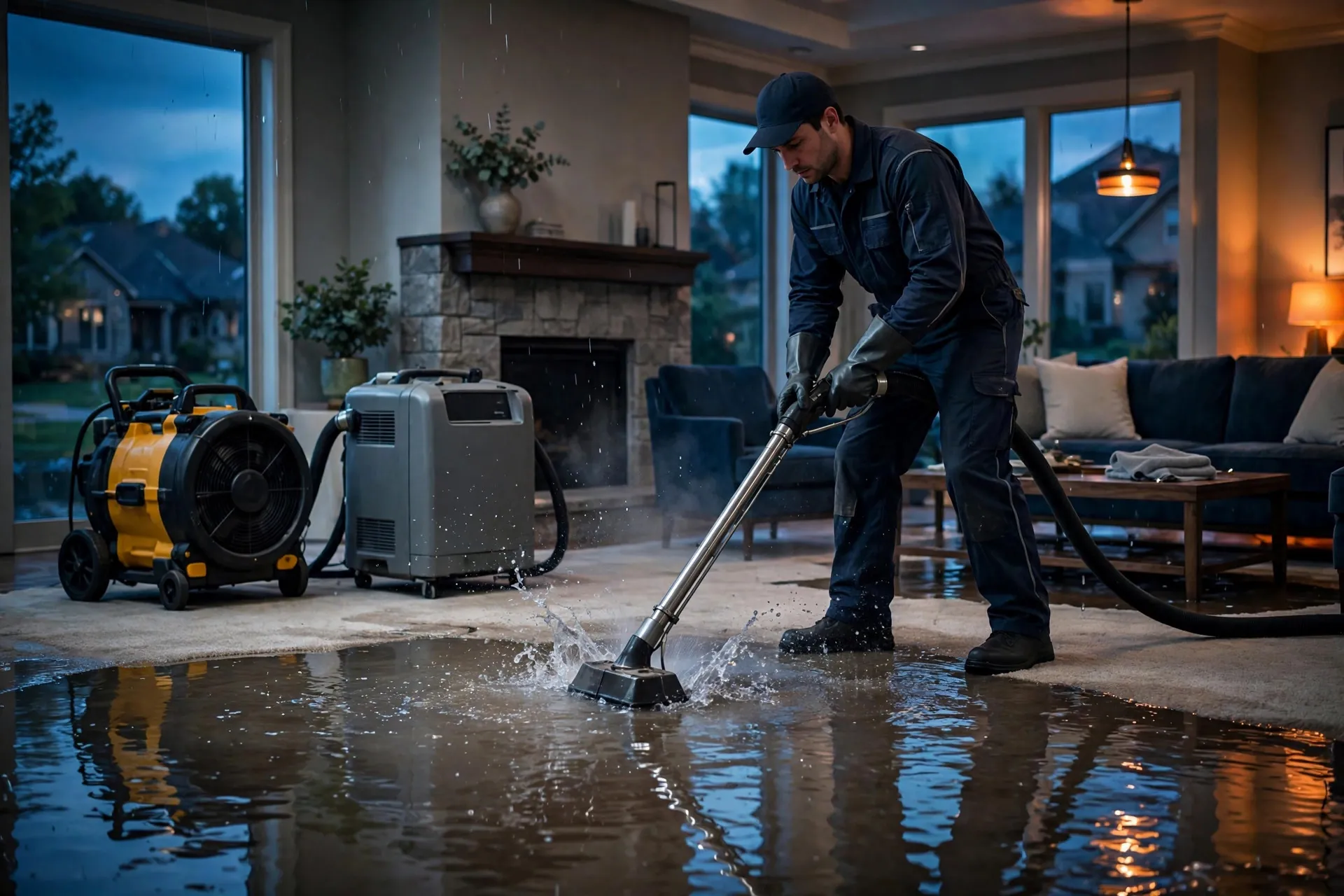
When water is standing on your floor, every hour pushes it deeper into carpet pad, subfloor and the bottoms of your walls. Our Tulsa crews pump out flood water and extract water from carpet, hardwood, tile and concrete using professional extraction equipment, then hand off to structural drying so what is left does not turn into mold. We answer 24 hours a day and aim to arrive within 60 minutes across Tulsa County.
Emergency water extraction is the physical removal of standing and absorbed water from a building using pumps and vacuum extractors, before any drying equipment is set up. Removing liquid water first is far faster than evaporating it, which is why extraction is always the first step after a flood, pipe break or appliance overflow.
When should you call? Any time water is pooled on the floor, soaking carpet, or still coming in. Do not wait for it to dry on its own. Tulsa's humid summers slow natural drying, and mold can begin on damp materials within 24 to 48 hours.
Know What You Are Dealing With
How Much Water Is on Your Floor? A Quick Estimate
One inch of water looks small, but it is a lot of water. Use this table, or the formula below it.
Floor area
1/4 inch of water
1 inch
2 inches
500 sq ft
about 78 gal
about 312 gal
about 623 gal
1,000 sq ft
about 156 gal
about 623 gal
about 1,247 gal
1,500 sq ft
about 234 gal
about 935 gal
about 1,870 gal
2,000 sq ft
about 312 gal
about 1,247 gal
about 2,494 gal
Formula: square feet x depth in inches x 0.623 = gallons.
One inch across 1,500 sq ft weighs roughly 7,800 pounds. That is why a "small" flood is not small, and why a shop vac holding 5 to 16 gallons cannot keep up.
The Science
Why Extraction Comes Before Drying
Water is heavy and stubborn. Turning a single pound of liquid water into vapor takes roughly 970 BTU of energy, so dehumidifiers and air movers are built for the moisture left inside materials, not for pools of liquid.
That is why professional crews follow one rule: remove what you can physically remove, then dry what remains. Skipping or rushing extraction stretches drying by days, keeps humidity high and gives mold and odor time to set in.
Extraction also does three things right away:
Protects carpet backing and adhesives, which break down when soaked for long periods.
Cuts off wicking, where water climbs drywall and baseboards by capillary action.
Lowers risk around electrical outlets, wall cavities and floor framing.
Pro-Grade Gear
Extraction Equipment We Use in Tulsa
Shop vacs move too little air and too little water to pull moisture out of pad, subfloor and slab. We bring equipment sized to the job.
Truck-Mounted Extraction Units
Vehicle-powered vacuum systems with high lift and airflow let us run long hose lines into multi-level homes and commercial spaces while wastewater goes straight to an outside tank. Best for large carpeted areas and fast whole-floor extraction.
Submersible Trash Pumps
For flooded basements, crawl spaces and ground-level properties with several inches or feet of water, submersible pumps handle silt and debris and move large volumes quickly.
Weighted Extractors and Sub-Surface Tools
Weighted tools and roving extractors compress carpet and pad while pulling vacuum, so water comes out of the cushion beneath the carpet without tearing up the room.
Hard-Surface Extraction Wands
Sealed-edge wands for tile, vinyl, laminate and concrete pull water from the surface and from grout lines, thresholds and baseboard edges.
Moisture Meters and Thermal Imaging
After bulk water is out, we check for hidden wet areas in subfloor, wall bases and slab using moisture meters and a thermal camera.
How We Work
Our Water Extraction Process
01
Safety check and source control.
We look for electrical hazards and structural risk from soaked ceilings, and shut off the water source if it is still running.
02
Water category and class assessment.
We identify whether the water is clean, gray or black, and how far it has spread. This decides what can be saved.
03
Bulk water removal.
Pumps or truck-mount lines remove standing water, starting at the lowest points and working outward.
04
Carpet, pad and floor extraction.
Weighted and hard-surface tools pull water out of carpet, pad, wood and slab. Contaminated pad is cut out and bagged.
05
Moisture verification.
We check what is still wet inside floors and wall bottoms so nothing is left behind.
06
Handoff to structural drying.
Air movers and dehumidifiers take over to dry remaining moisture. See Water Mitigation.
Know the Labels
Water Categories and Classes What They Mean for Your Home
Two labels decide how your job is handled. Category describes how contaminated the water is. Class describes how much water there is and how deep it has gone.
Water Categories
Category
Typical source
Extraction approach
Category 1 (clean)
Supply line, faucet, tub overflow, early rain intrusion
Extract and dry. Carpet and often pad can be saved if work starts quickly
Category 2 (gray)
Washing machine, dishwasher, sump pump discharge
Extract and treat. Pad is usually replaced and some materials are discarded
Category 3 (black)
Sewage, river or ground flood water, long-standing water
Containment and careful extraction. Porous materials are removed
Clean water can become a worse category if it sits, usually after about 48 to 72 hours. Flood water entering from outside is treated as Category 3. For sewage, see Sewage Backup Cleanup.
Water Classes (ANSI/IICRC S500)
Class
Meaning
Typical Tulsa example
Class 1
Small area, low-absorption materials
Small leak on tile, caught quickly
Class 2
Whole room, carpet and pad wet, water wicking up walls
Washing machine overflow, burst supply line
Class 3
Water from above, ceilings, walls and insulation saturated
Roof leak after a storm, upstairs pipe failure
Class 4
Deeply bound water in dense materials like hardwood, plaster, concrete
Long-term leak or delayed response
Damage Control
What Can Be Saved After Extraction
Carpet: often saved with fast extraction of Category 1 water. Pad is frequently replaced.
Hardwood: can sometimes be saved with fast extraction and specialized drying. See Hardwood Floor Drying.
Tile, vinyl and concrete: water is removed from the surface and joints, and the slab and subfloor are checked and dried.
Drywall and baseboards: if water has wicked upward, wet sections may need to be cut out. See Ceiling & Drywall Repair.
Furniture and contents: moved off wet floors and blocked up to limit stains and swelling.
Before We Arrive
What to Do in the First Hour Before the Crew Arrives
01
Stop the source.
Shut off the main water valve (at the meter box near the street, or inside near the water heater).
02
Electrical safety.
Turn off breakers only if the panel is dry and you are not standing in water. If water is near the panel or outlets, leave and call PSO or a licensed electrician.
03
Gas smell?
Leave immediately and call Oklahoma Natural Gas or 911.
04
Photograph and video everything before moving anything.
05
Lift what you can
rugs, small furniture, electronics, paper and valuables.
06
Block furniture legs
with foil or wood blocks to stop stain transfer on wet carpet.
07
Avoid household vacuums, space heaters and bleach.
Waiting for the insurance adjuster before extracting. Limiting further loss is expected right away.
Running a heater or heat gun on wet carpet.
Using fans before extraction. They move moisture around and spread odor.
Walking on wet carpet, which pushes water into the pad and subfloor.
Using a standard shop vac near outlets, cords or standing water with power on.
Pulling up carpet and pad yourself without knowing the water category.
Trusting a dry-looking surface. Wall bottoms and subfloor can still be wet.
Local Knowledge
Why Tulsa Properties Flood and Take On Water
Creek and river runoff.
Tulsa sits along the Arkansas River and is crossed by creeks that rise quickly in heavy rain. Areas near Riverside Drive, Mingo Creek, Joe Creek and Bird Creek can see street flooding that overwhelms yard drainage and enters garages, basements and ground-floor rooms. The May 1984 flood and the 2019 Arkansas River flooding both affected homes and businesses across the area.
Expansive clay soil.
Much of the Tulsa area sits on clay that swells when saturated. Pressure against foundations can push moisture through floor joints, wall bases and slab cracks.
Older homes and plumbing.
Neighborhoods like Midtown, Maple Ridge, Brookside, Cherry Street and the Pearl District include older houses where aging supply lines, cast-iron drains and water heaters can fail.
Severe storms.
Spring storms bring heavy rain, hail and roof leaks that send water through ceilings and into walls.
Winter freezes.
Hard freezes, like the February 2021 winter storm, can split pipes in attics, exterior walls and crawl spaces and release water while no one is home.
Not sure we cover your address? Call (918) 347-0890 and we will tell you right away.
Honest Pricing
What Affects the Cost of Water Extraction
Depth and volume of water
Square footage and number of rooms or floors
Water category (clean, gray or black)
Materials involved (carpet, pad, hardwood, slab)
Access and time of day
Whether drying and demolition follow extraction
A quick extraction costs far less than one that waits days, so calling early almost always lowers the final cost. We give an estimate over the phone and again on arrival.
Insurance Claims
Water Extraction and Your Insurance Claim
Call us first, then your insurer. We start extracting right away so damage does not grow while the claim is opened.
We provide photos, moisture readings and drying records, and work with your adjuster. Coverage is decided by your insurer. Questions about your coverage? Call (918) 347-0890.
Good Judgment
Do It Yourself or Call a Professional?
A wet/dry vacuum can handle a small spill on a hard floor. Call a professional when:
Water is more than a thin film or has soaked carpet
It is still coming in
It came from a sewer, toilet or flood
It is in a basement, crawl space or near electrical panels
It has been wet for more than 24 hours
Anyone in the home is elderly, pregnant, a young child, or has breathing problems
Water Extraction FAQ
Water Extraction FAQ
We run 24/7 emergency dispatch and aim to arrive within 60 minutes in most of the Tulsa metro. Distance, traffic and weather can change that, and we give you an honest arrival time when you call.
For a small spill on a hard floor, yes. For water in carpet, pad or a basement, or more than about an inch deep, a shop vac does not move enough air or water and leaves moisture behind. Never use one near standing water if outlets or cords are involved.
Not always. Pad is often replaced when the water was contaminated or has been wet for a long time. Clean-water pad can sometimes be saved if extracted quickly. A technician tests and decides on site.
Most home extractions take a few hours, depending on the volume of water and how many rooms are affected. Large floods, deep basements and crawl spaces can take longer. Drying after extraction usually takes several more days.
Yes. An inch of water across a typical floor is hundreds of gallons, and it soaks carpet, pad and wall bottoms quickly. Extraction is the fastest way to limit what you have to replace.
Yes. Flood water from outside can carry bacteria, chemicals and debris, and is treated as contaminated. Avoid contact, wear boots and gloves, and keep children and pets away until it is removed.
Shut off the main water if the source is inside. Turn off power to the area at the breaker only if you can do so safely without standing in water. If water has reached the panel or meter, stay out and call your power utility or a licensed electrician. Move valuables off the floor and take photos.
Often, if the water was sudden and accidental. Flood from outside is usually excluded unless you have flood insurance. Call us to start extraction immediately, then contact your insurer. Do not wait for approval before limiting the damage.
Yes, using submersible pumps, followed by extraction and drying. See Flooded Basement & Crawl Space Cleanup.
Yes. We are available 24 hours a day, 7 days a week.